
We no longer know how to decide.
AI is only making the problem visible.
Decision architecture & AI: this is not a technology issue
It is political.
Organizational.
Economic.
Systemic.
Across industries — healthcare, finance, energy, public policy —
decisions are becoming both more critical and more complex than ever.
And yet:
👉 the higher the stakes,
👉 the more fragile decision-making becomes.
The real issue is structural
Organizations already have:
– data
– tools
– models
But they lack something more fundamental:
👉 a clear decision architecture
Decision-making is not an act.
It is a system.
A system that defines:
– who decides
– based on what
– how decisions turn into action
– and who remains accountable over time
What AI actually changes
AI does not just improve tools.
It changes the nature of decisions.
We no longer decide only based on observable facts.
We increasingly decide based on probabilities.
– risk scoring
– predictive models
– automated recommendations
👉 Decision-making is shifting.
The hidden shift
In many organizations:
– systems prepare decisions
– models influence outcomes
– interfaces constrain choices
Between the field and the customer, a new layer has appeared:
👉 decision assistance
But who is actually deciding?
The human?
The model?
The system?
The real risk
The problem is not error.
It is the absence of clear accountability.
– Who is responsible if the model is wrong?
– Who owns a decision shaped by algorithms?
Without clarity:
👉 decisions become harder to challenge
👉 but no one truly owns them
Decision architecture & AI : what we observe across decision systems
Across organizations, five recurring failure patterns emerge:
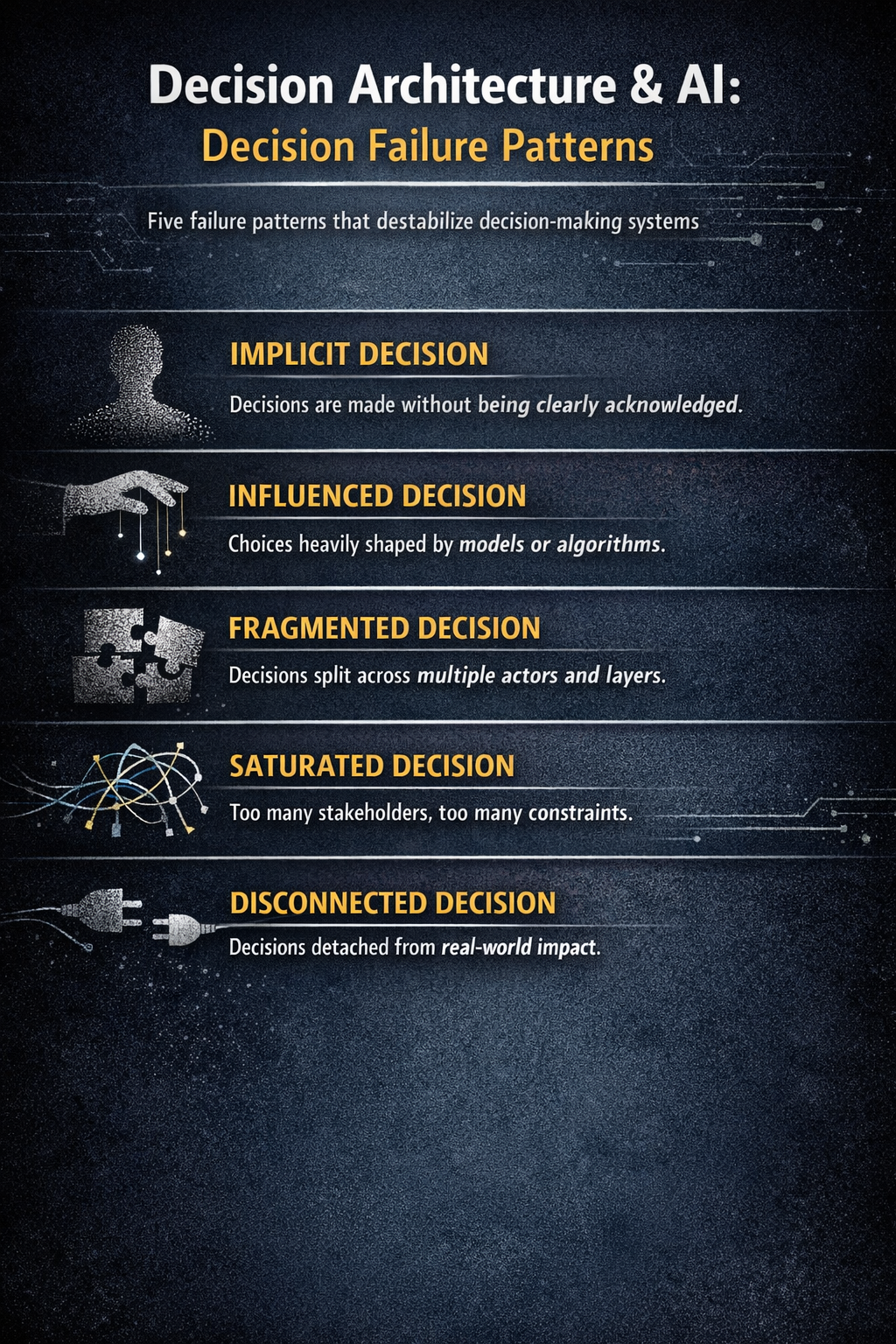
- Implicit decisions
- Influenced decisions
- Fragmented decisions
- Saturated decisions
- Disconnected decisions
AI does not fix these issues.
👉 It amplifies them.
Faster.
Stronger.
More visibly.
A systemic approach
Decision-making cannot be treated as an isolated act.
It must be designed and governed as a system.
👉 Decide
👉 Deliver
👉 Govern
Without this alignment, organizations drift.
Where to start
Before transformation, a simple question:
👉 Where is the decision actually made?
👉 And who is accountable for it?
Key insight
A probabilistic decision does not reduce uncertainty.
It displaces it.