
Delivering is not producing outputs.
It is not shipping features.
It is not closing tickets.
Delivering means making something usable.
Making value receivable.
Making work actionable for someone else.
Delivery begins where production ends.
It starts at the exact moment when responsibility can no longer be hidden behind effort.
To deliver is to assume responsibility not for what was produced — but for what is actually received.
Delivering vs deciding definition content
Decision creates possibility.
Delivery creates consequence.
Why do organizations deliver so much yet receive so Little?
Many teams move fast.
They produce constantly.
They ship relentlessly.
And yet:
- value arrives late,
- decisions dissolve,
- outcomes fragment,
- ownership fades.
Delivery happens. Reception doesn’t.
This paradox is rarely caused by a lack of effort or competence.
It is almost always caused by a broken flow.
Delivery is a flow problem, not a productivity problem
Most organizations try to improve delivery by accelerating production.
They add capacity.
They optimize velocity.
They increase output.
But delivery is not acceleration.
Delivery is transmission.
Value must travel:
- from intent → to decision
- from decision → to use
- from use → to learning
When that chain breaks, delivery becomes an illusion.
What looks like progress is merely motion.
The invisible breakpoints between deciding and delivering
Three silent fractures typically appear inside teams:
1 — Production replaces intention
Work continues even when purpose has faded.
2 — Delivery replaces decision
Teams ship what was started instead of what is still meaningful.
3 — Activity replaces accountability
Everyone is busy, but no one owns the outcome.
None of these failures are visible on dashboards.
They appear only when someone asks:
“Who actually received value from this?”
Making delivery observable
Before improving delivery, teams must be able to see it.
Not track tasks.
Not count outputs.
See delivery.
That requires different artefacts than traditional tracking tools.
Within Campus In Imago’s February cycle, two complementary exploration boards were designed to make delivery visible before attempting to optimize it.
Flowcast Board — Governing Delivery

A visual thinking space used to surface assumptions about:
- work in progress
- decision density
- feedback latency
- responsibility zones
- friction points inside team interactions
Its purpose is not planning.
Its purpose is clarification.
Figma Content Delivery — Flowcast Board
Flowcast Board — Governing Delivery
A second exploration layer designed to make bottlenecks discussable.
Rendre visibles les frictions de flux pour décider collectivement ce qui mérite d’être livré — et ce qui ne le mérite plus.
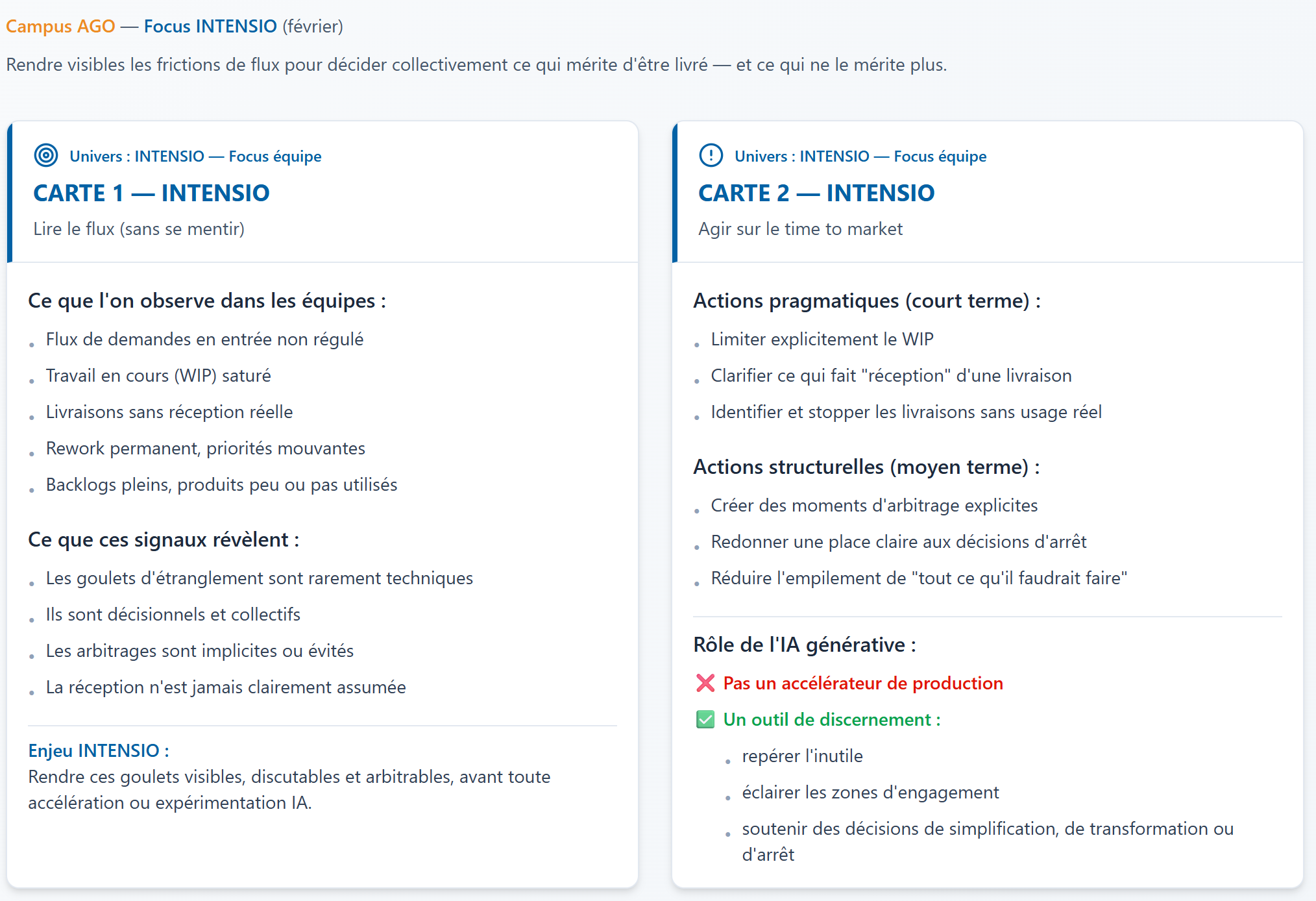
Not to diagnose teams.
Not to evaluate performance.
But to make one thing possible:
Collective arbitration.
When flow becomes visible, teams can finally decide:
- what deserves to be delivered,
- what should be paused,
- what must stop.
Delivery governance starts exactly there.
Not in control.
In shared visibility.
Concept Board — Reading Delivery
A visual thinking space used to surface assumptions about:
- work in progress
- decision density
- feedback latency
- responsibility zones
- friction points inside team interactions
Its purpose is not planning.
Its purpose is clarification.
Because unclear delivery cannot be improved — it can only be accelerated blindly.
Delivering Means Choosing What Not to Deliver
The deepest misunderstanding about delivery is this:
People believe delivery is about finishing work.
It is not.
Delivery is about selection.
Every act of delivering implicitly answers three questions:
- What is worth finishing?
- What is no longer worth continuing?
- What must never start?
Teams that cannot answer these questions do not lack discipline.
They lack a delivery conversation.
February — Deliver (Intensio Perspective)
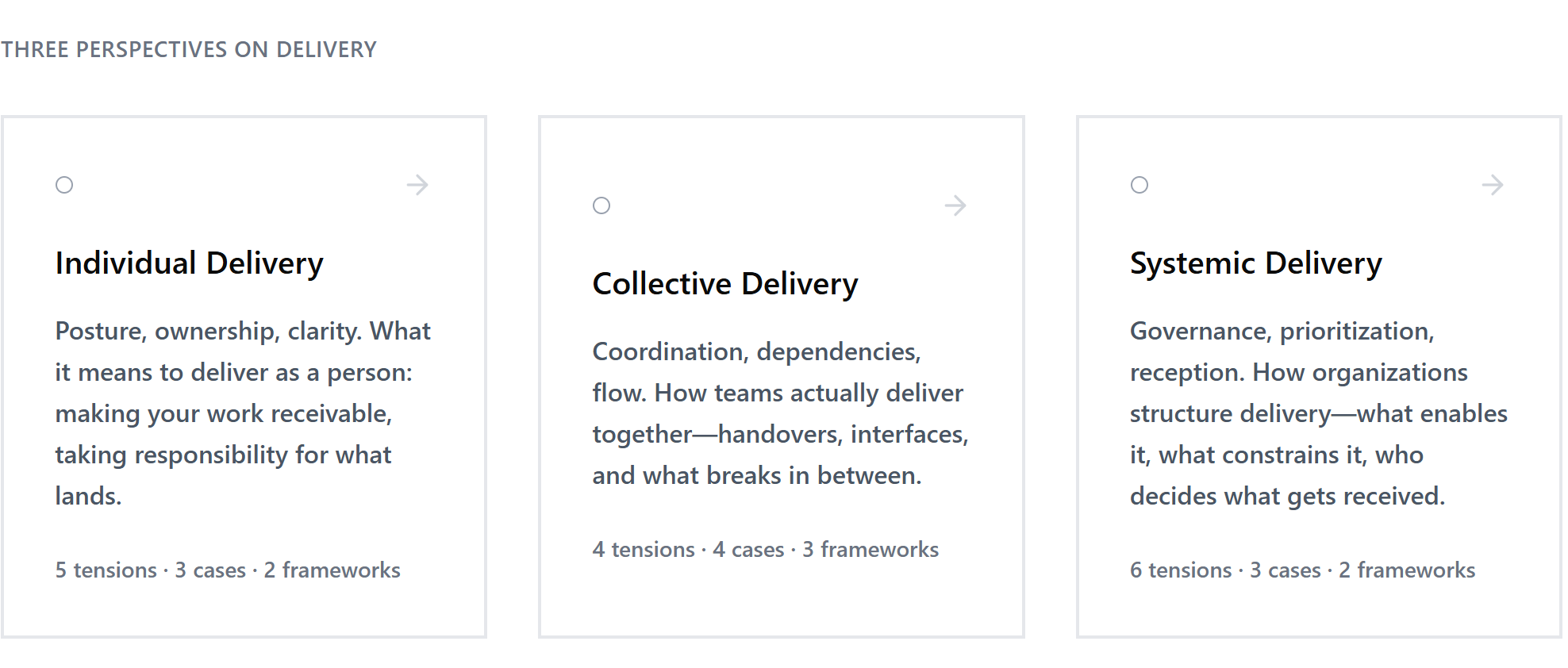
This month’s work focuses on the team level.
Not strategy.
Not organization-wide governance.
The team.
Because delivery does not fail first at scale.
It fails locally.
Inside conversations.
Inside handoffs.
Inside unclear decisions.
Inside silent assumptions.
Strengthening delivery therefore begins with a simple shift:
From managing work
to making value travel.
Where Delivery Actually Begins
Delivery does not begin when work starts.
It begins when someone can receive it.
That is why:
- producing is not delivering
- shipping is not delivering
- finishing is not delivering
Receiving is the only proof of delivery.
Closing Insight
Organizations rarely suffer from a lack of effort.
They suffer from a lack of transmissible value.
And transmissible value requires one discipline above all:
Making delivery visible enough
for responsibility to exist.n also: