
Generative AI reshapes organisational design, governance and human responsibility. It is a strategic framework for leaders navigating AI-driven change.
Why Generative AI Is reshaping Enterprise organisation ?
As GenAI accelerates decision-making, shortens learning cycles, and embeds itself in everyday workflows, traditional pipeline-based organisations reach a breaking point. Governance becomes a bottleneck, silos slow down value creation, and unclear responsibilities prevent use cases from scaling.
This article argues that successful GenAI adoption requires a shift from linear, control-driven structures to living organisational systems—capable of connecting expertise, distributing responsibility, and evolving at the pace of usage. It examines what Generative AI reveals about structural dysfunctions, explores emerging organisational models, and outlines how leaders can reorganise without destabilising their enterprise.
The GenAI challenge is not an IT or data issue.
It is a leadership and organisational design challenge.
And why now ?
Generative AI is accelerating organisations faster than people can adapt. Beyond structural inefficiencies, many teams experience loss of meaning, decision fatigue, and blurred accountability. Reorganising for GenAI is therefore not only about performance, but about preserving human judgment, responsibility, and trust at scale.
- Organising the Enterprise for Generative AI (GenAI)
- From Reactive Organisations to AI-Driven Enterprises
- The Limits of Pipeline-Based Organisations
- From Data Architecture to living Organisations
- Organising for Generative AI is also a human challenge.
- What Generative AI reveals about organisational dysfunction
- Organisational models for scaling Generative AI
- Reorganising without losing direction
- Building organisations able to move at AI Speed
Organising the Enterprise for Generative AI (GenAI)
At the age of Generative AI, it is not only technology that is evolving.
The enterprise itself is being reshaped.
Designing an organisation capable of learning, connecting expertise, and acting with discernment has become a strategic challenge. What is at stake is no longer the deployment of tools or the optimisation of isolated processes, but the way collective work reorganises itself when artificial intelligence enters everyday workflows and decision-making.
In Understanding Generative AI, the focus was placed on technical foundations: models, architectures, use cases, limitations, and potential. This step was necessary—but insufficient. Generative AI never operates in isolation. It subtly reshapes behaviours, trade-offs, information flows, and the way roles interact.
This transformation affects the very core of organisational life:
how decisions are made, how trust is built in systems, how responsibilities are distributed, and how quickly teams can learn and adjust.
The underlying question is therefore structural:
how can enterprises evolve their organisational design to keep pace with a system that learns and reacts continuously—without exhaustion, rigidity, or loss of judgment?
From Reactive Organisations to AI-Driven Enterprises
Generative AI does not merely increase productivity or improve interfaces.
It shifts the conditions under which organisations operate.
What many companies had already experienced with data—fragmentation, silos, slow coordination, and organisational debt—becomes increasingly incompatible with augmented work. While traditional structures could tolerate long validation cycles and sequential handovers, GenAI operates at a conversational and continuous rhythm.
In this context, the central question changes.
It is no longer about choosing the right technology, but about whether the organisation itself is able to absorb, regulate, and benefit from it.
Technology stops being the limiting factor.
Organisational design becomes the real constraint—or the main lever.
The Limits of Pipeline-Based Organisations
For years, enterprises have relied on linear pipeline models to manage data and decisions:
collection, preparation, governance, usage, then action.
This approach brought clarity and control, but it also introduced structural inertia. Pipelines are sequential by nature, heavily dependent on arbitration, and prone to friction between IT, data teams, business units, and compliance functions.
A paradox gradually emerges:
the more the organisation tries to secure and control, the slower it becomes—and the harder it is to create value.
With Generative AI, this tension intensifies. Use cases multiply, expectations accelerate, and collaboration becomes increasingly transversal. The pipeline no longer acts as a stabilising structure; it turns into an organisational bottleneck.
Reorganising for GenAI therefore implies moving beyond a purely data-centric system toward a more adaptive organisational logic.
From Data Architecture to living Organisations
To be deployed at scale without losing meaning or human oversight, Generative AI requires organisations that can adapt continuously. This is not an abstract vision, but a functional requirement.
Such organisations are characterised by their ability to connect expertise across boundaries, adjust roles and processes as usage evolves, distribute responsibility closer to action, and support local initiatives without losing coherence.
This shift relies on three core principles.
Connection.
AI, data, business, and risk functions no longer operate as isolated domains. They interact as neighbouring capabilities, linked by frequent exchanges rather than formal handovers.
Evolvability.
Rules, processes, and responsibilities are not fixed once and for all. They evolve in response to real usage, learning loops, and feedback from the field.
Flow.
Information and decisions circulate continuously. Authority is not replaced, but exercised through coordination rather than vertical escalation.
Together, these principles redefine organisational design for an AI-enabled context.
Organising for Generative AI is also a human challenge.
As organisations accelerate decision-making and automate parts of reasoning, the risk is not only structural overload, but human disorientation. GenAI increases cognitive intensity, blurs responsibility boundaries, and can weaken the sense of agency if governance and roles are not explicitly designed to protect human judgment.
Adaptive organisations are not only efficient systems; they are environments where people can understand their role, exercise discernment, and remain accountable for decisions—even when intelligence is augmented. Reorganising for GenAI therefore means designing structures that support trust, learning, and responsibility, rather than replacing them with automation or abstraction.
What Generative AI reveals about organisational dysfunction
Long before GenAI, data governance already acted as a mirror of organisational tensions. With artificial intelligence, these same issues become critical obstacles.
Duplicated processes, excessive validation layers, unclear ownership, dependency on a small number of experts, and endless committees all slow down learning and execution. What once appeared manageable now generates cost, frustration, and loss of momentum.
In this sense, Generative AI functions like an organisational MRI. It exposes bottlenecks, hidden dependencies, and structural incoherences.
A recurring paradox illustrates this reality:
many organisations identify promising use cases but fail to industrialise them.
In most situations, the root cause is not technological. It lies in governance arrangements, unclear interfaces, and misaligned responsibilities.
Data governance has long served as a mirror for organisational tension points — duplicated processes, role ambiguity, and unbalanced validation chains. In the era of Generative AI, these invisible tensions become visible and critical bottlenecks, slowing down learning loops and value creation.
Our exploration of Generative AI as an organisational MRI parallels findings in data governance: many structures struggle not because of technology, but because they have not addressed the underlying tensions in decision rights, information flows and accountability.
These organisational tensions have already been observed in data governance, which often acts as a revealer of invisible organisational stress — see Data governance as a revealer of invisible tensions.
This connection between governance and organisational health highlights that GenAI challenges are not simply technical — they are inherently human and structural.
Organisational models for scaling Generative AI
In response, several organisational models are emerging.
The federated model grants strong autonomy to business domains, allowing them to develop their own use cases with limited central coordination. This approach favours speed and ownership but increases the risk of duplication and fragmentation.
The hub-and-spoke model relies on a central AI or data function that defines standards, ensures quality, and supports distributed teams. It provides coherence and risk control, yet may introduce new bottlenecks as demand grows.
The distributed ecosystem model, inspired by data mesh principles, distributes skills and accountability across teams while sharing governance responsibilities. It offers scalability and fluid collaboration but requires a mature culture and strong alignment.
There is no universally optimal choice. The relevance of each model depends on organisational culture, maturity, and strategic ambition regarding Generative AI.
Reorganising without losing direction
Reorganisation does not start with redefining roles or drawing new org charts. It begins with understanding real flows: how decisions are made, how information travels, and how teams interact.
Effective governance in an AI context creates short, frequent coordination spaces connected to actual usage. It provides clear mandates to hybrid teams, balancing autonomy with strategic alignment.
Above all, leaders must accept that the final structure cannot be fully designed upfront. An AI-enabled organisation is tested, adjusted, and regulated over time through practice and learning.
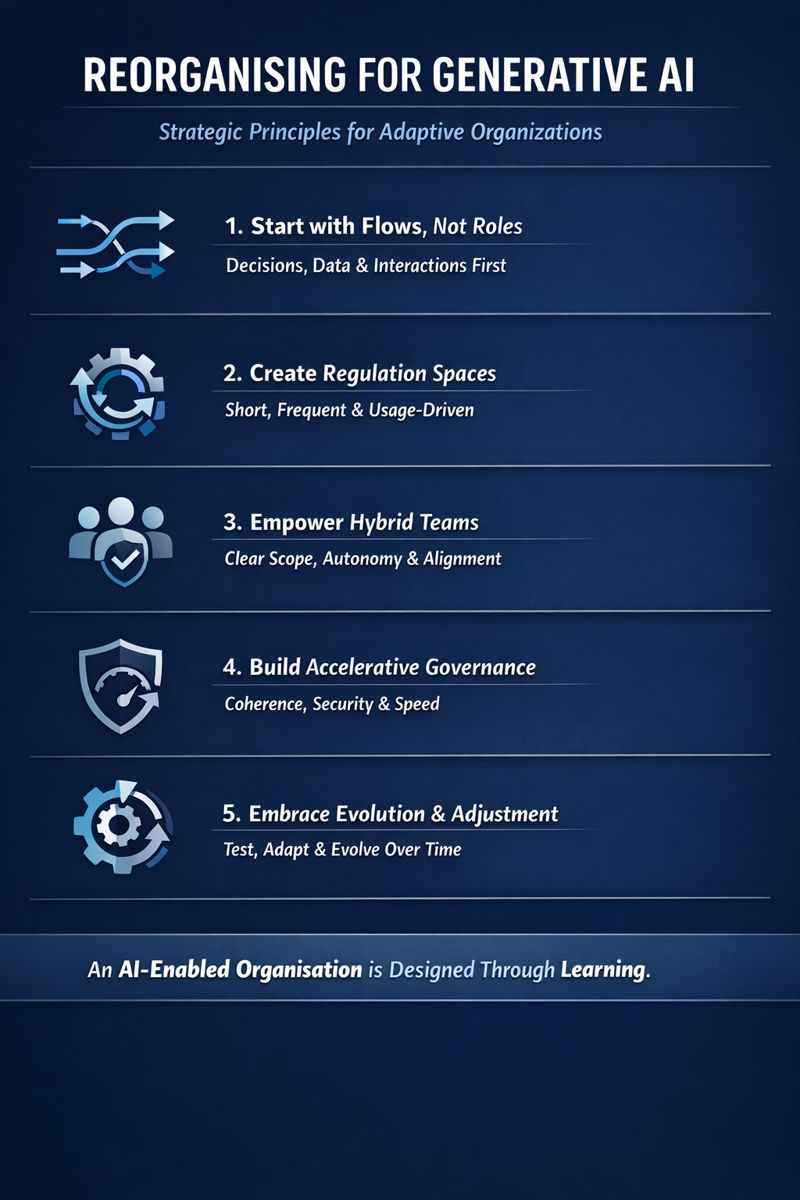
This infographic highlights five strategic principles for reorganising enterprises in the age of Generative AI.
Rather than focusing on roles or tools, it emphasises flows, transversal regulation, empowered hybrid teams and accelerating governance. Together, these principles outline how organisations can evolve continuously, maintain coherence, and learn at the pace imposed by AI-driven environments.
1. Start with flows, not roles
Begin with reality: decisions, data, and interactions.
2. Create transversal regulation spaces
Short, frequent, and closely connected to actual usage.
3. Give hybrid teams a clear mandate
Defined scope, autonomy, and strategic alignment.
4. Build governance that accelerates
Coherence, security, and fluidity.
5. Accept that the final model is not known in advance
An AI-enabled organisation is tested, adjusted, and continuously regulated.
Building organisations able to move at AI Speed
Generative AI is not simply another tool to integrate.
It introduces a new rhythm—faster learning cycles, continuous interaction, and ongoing recalibration.
Organisations that will thrive are those that recognise this shift early and invest accordingly. Not by chasing technology trends, but by evolving their organisational design and governance to remain coherent, resilient, and human at scale.
The challenge of Generative AI is therefore not primarily technological.
It is the challenge of becoming an organisation capable of learning and adapting continuously.
Further reading
Impact of Generative AI on enterprises and future challenges
https://www.make-world.org/ia-generative-impact-sur-les-entreprises-et-enjeux-futurs/
About the author
Dominique [Nom] works with leadership teams on organisational design, governance and product strategy in complex environments. She focuses on helping organisations scale Generative AI while preserving human judgment, responsibility and coherence.